Beyond Vitamin C+E: The Next Generation of Antioxidant Intelligence
For beauty people, there is a certain confidence around vitamins C and E. Skincare’s most beloved antioxidant duo: iconic, influential, still invited everywhere.
Their chemistry earned the loyalty. Vitamin E works in lipid-rich environments, including the membranes that surround cells. Vitamin C operates in water-based ones. When vitamin E becomes oxidized in the course of antioxidant activity, vitamin C can help regenerate it through electron transfer. The two are not simply layered together; they participate in a relationship.
That relationship remains elegant. The environment around it has become more demanding.
Daily skin life unfolds under UV exposure, pollution, visible light, and the ordinary metabolic activity of cells themselves. Oxidative stress is rarely a single dramatic event. It is cumulative, ambient, and deeply unglamorous: like the slow chemistry of being alive in a city, in a body, in time.
The Classic C + E Era
Much of the vitamin C conversation has centred on concentration: higher percentages, new derivatives, greater stability. Important questions, certainly. They are not the only ones.
Antioxidant care is at its most compelling when it considers what happens after the first exchange. Vitamin C and E offer the classic example, while glutathione belongs to the wider cellular redox network involved in maintaining reduced antioxidant forms. This is the intelligence of a system - molecules do not merely arrive, act once, and disappear. Their activity is shaped by their environment, their stability, and the chemical relationships around them.
The next question for skincare is not simply how strong an antioxidant can be. Rather, it is how thoughtfully a formula can be composed.
Our Redox Upgrade
Better signals make better skin.
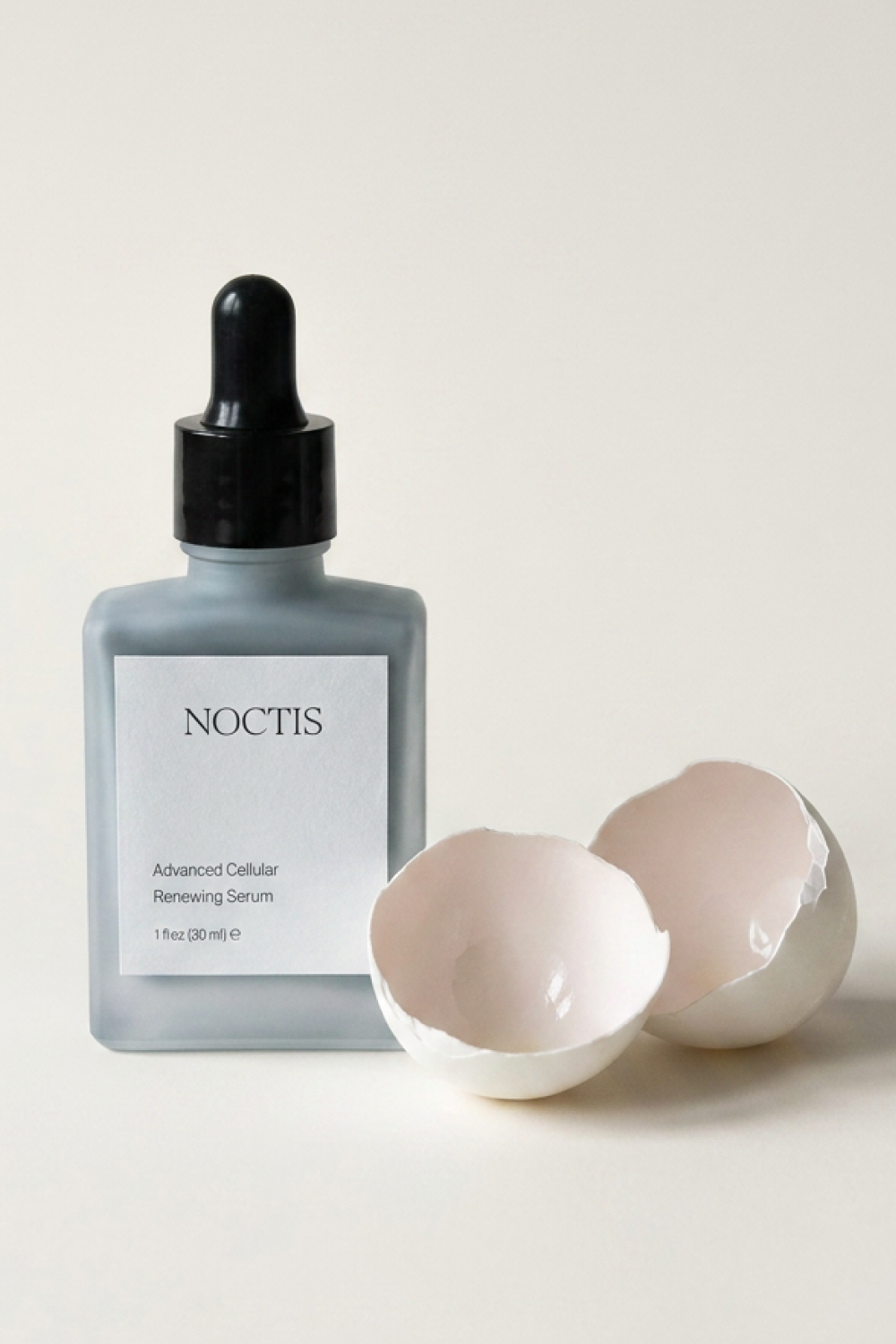
Our PHYREDOX™ system pairs a network of antioxidants—two operating within water-rich environments, the other embedded in lipid membranes. Together, they form a redox-active complex that can continue exchanging electrons where oxidative stress first arises, particularly in and around the mitochondria.
Their presence in the same formula reflects NOCTIS’s interest in the molecular exchanges that sit beneath the visible concerns of skincare: energy, oxidative balance, and a more complex web that underlies an antioxidant network.
The formula has a deliberately systemic point of view—one grounded in the conversation between ingredients, rather than their accumulation.

Better than strong, smarter
Vitamin C remains a cornerstone of a thoughtful routine. NOCTIS isn't asking for a breakup with the classics. It is an invitation to look closer at the chemistry that made them classic in the first place.
The future of antioxidant care may belong less to escalation—to ever-higher percentages, or stronger claims—and more to precision. To formulas that respect the complexity of skin. To molecular relationships. To the invisble, ongoing exchange of electrons beneath the surface.