The Energy Angle
Why the more interesting story about aging skin begins several layers beneath the one we usually tell.
Lots of talk around aging is as though it were a surface event — a matter of fine lines, dullness, or of the slow retreat of bounce and the lengthening of recovery time. It is a tidy story, but an incomplete one. The more interesting version begins further down, in the unglamorous machinery by which skin cells make and spend energy.
Skin is not passive tissue. It is a living organ, endlessly repairing and defending and regenerating itself under duress - and that labour runs on mitochondria, the organelles that generate ATP through oxidative phosphorylation. When mitochondrial function falters, skin is left with less to spend: less capacity to repair, to hold its structure, to absorb the oxidative noise of an ordinary day. The literature has been drifting this way for some time, increasingly framing mitochondrial dysfunction, redox imbalance, and mitochondrial DNA damage as central contributors to both intrinsic aging and photoaging. 1
Which reframes the whole question. Aging is not only the damage done to the skin. It is also a matter of whether the skin still has the energetic means to answer it.
Why electrons, of all things
Mitochondria make energy by moving electrons along the electron transport chain. 2 Abstract as that sounds, the practical consequence is plain enough: efficient electron flow is needed to support ATP production, while inefficient flow raises the odds of electron leakage and the formation of reactive oxygen species. In skin, that imbalance is not a footnote. Oxidative stress touches everything from collagen integrity to inflammatory signaling to the capacity to repair at all.
It is also why the word antioxidant, used flatly, only tells half the story. Antioxidants can lower oxidative stress, yes - but they do not all engage the same biology. Some merely neutralize reactive species after the fact.
Others reach further in, interacting with mitochondrial redox pathways and the business of energy production itself. That distinction is the whole reason certain ingredients read as more interesting than another entry in the free-radical genre.

Where CoQ10 belongs
CoQ10 is among the most defensible ingredients in this conversation, for a simple reason: it is not a visitor to the energy system. It is a native component of the mitochondrial respiratory chain itself, where it helps shuttle electrons as part of oxidative phosphorylation. It belongs to the cellular-energy story in a way the classic antioxidants never quite do (& never quite can never quite can).
The skin-aging literature bears this out with unusual clarity. A review in PubMed notes that CoQ10 is essential for bioenergetics, offers antioxidant protection against UV-mediated oxidative stress, can influence the expression of skin proteins, and may decrease metalloproteinases (MMPs) such as collagenase. A more recent review reports, in much the same spirit, that topical CoQ10 can replenish cellular levels, normalize energy homeostasis, and reduce the visible signs of aging. Which is probably where the most interesting thing about CoQ10 lies - as it is not simply an antioxidant that helps. It is part of the skin's own energy infrastructure. ³
That makes it a natural anchor at Arbor Skin. If a formula is built on the idea that skin performs better when its energy systems are supported, CoQ10 is the most literal expression of the thought.
Methylene blue, the unexpected one
Methylene blue is the ingredient that makes people stop and ask what, exactly, is going on here.
In a 2017 Scientific Reports paper, it was described as a mitochondrial-targeting antioxidant that outperformed both general and other mitochondrial-targeting antioxidants in stimulating skin fibroblast proliferation and delaying cellular senescence in vitro. In a reconstructed three-dimensional human skin model, and at very low doses, it improved skin viability, promoted wound healing, increased hydration and dermis thickness, and altered extracellular-matrix gene expression — including the up-regulation of elastin and collagen-related genes. That is a far, far broader set of effects than "it scavenges free radicals". ⁴
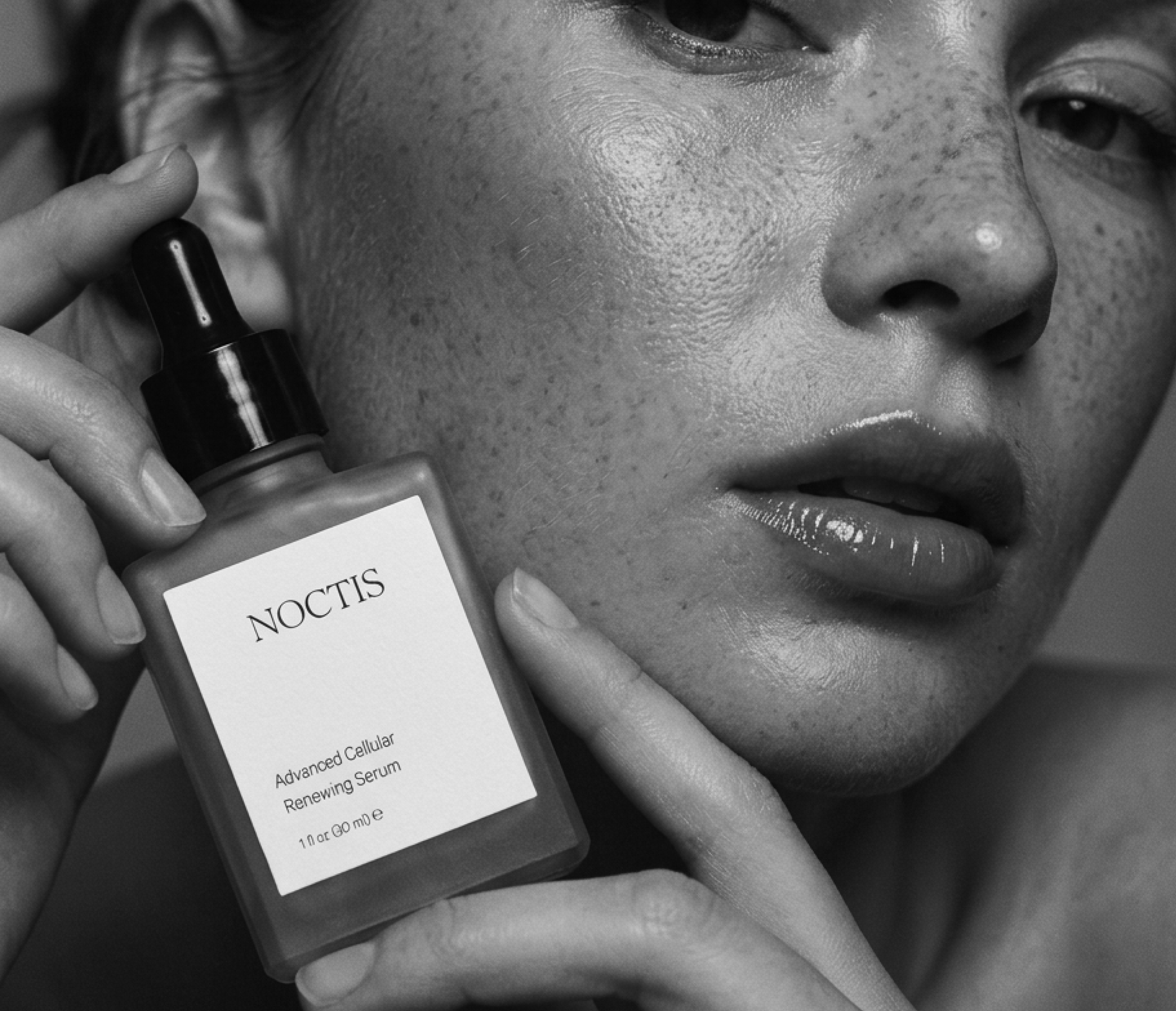
This is precisely what makes it interesting for a formula like NOCTIS. It seems to sit at the meeting point of redox chemistry, mitochondrial function, and matrix support, which lends something sturdier than another antioxidant serum. The claim is not only that it reduces stress, but that it may help support the skin's capacity to function more youthfully in the first place.
Why this is not a vitamin C serum
When the question arrives — what makes NOCTIS different from a serum built on vitamin C, or urolithin A, or the other longevity ingredients of the moment — the answer is not that those ingredients are beside the point. It is that Arbor is built around a different question: what if skin aging is a problem of energy flow?
This framing moves the product from antioxidant support to supporting the machinery that lets skin recover — and in doing so, all companion skincare works better, too.
The theory of the thing
The idea is simple enough to say aloud, and strong enough to build a house around.
Skin ages more visibly when it has less energetic flexibility. Mitochondrial dysfunction contributes to that decline — through ATP production, redox balance, oxidative stress, and repair signaling. If that holds, then a modern formula should not merely chase surface glow. It should support the internal systems that keep skin resilient under pressure.
Most skincare sets out to make skin look better from the outside. The more interesting ambition is to support the systems that let it keep looking well over time.
That is the energy angle. That is the electron story.